Physical Address
304 North Cardinal St.
Dorchester Center, MA 02124
Physical Address
304 North Cardinal St.
Dorchester Center, MA 02124

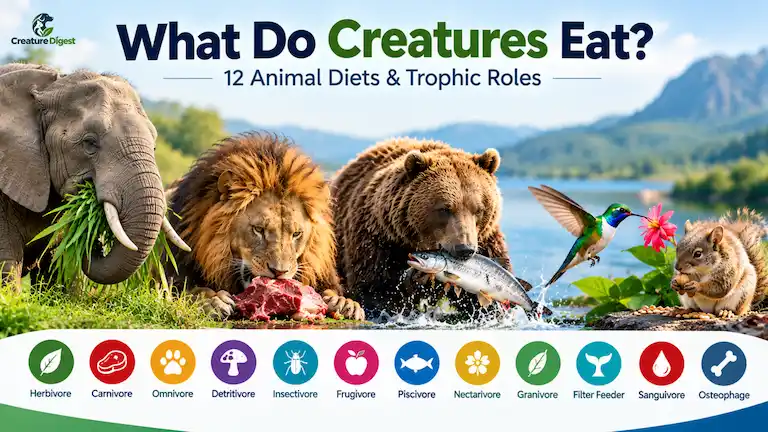
What do creatures eat? Animals eat plants, meat, dead waste, flower nectar, or blood. Most fit four main diets. Herbivores eat plants, carnivores eat meat, omnivores eat both, and detritivores eat waste. Eight special diets (insectivores, frugivores, piscivores, granivores, nectarivores, filter feeders, sanguivores, and bone-eating osteophages) plus six rare micro-diets also power the food web.
Watch a squirrel hide an acorn or a cat chase a bug. Every animal wakes up trying to find food without becoming food.
School books say cows eat grass, lions eat meat, and bears eat both, but real life isn’t that simple. Here are all 12 animal diets, their stomach acid, gut lengths, and how food energy works.
Diet is the food an animal swallows, but feeding strategy is how it gets that meal. Great white sharks and garden spiders are both carnivores, yet sharks chase ocean seals and spiders wait in webs.
Animals are also obligate or facultative. Obligate feeders need one strict food to live, while facultative guts handle backup foods too.
Take your pets. House cats are obligate carnivores like wild tigers. Their livers can’t make taurine from cysteine, vitamin A from plant beta-carotene, or arachidonic acid from linoleic acid, so they need real meat and organs.
Dogs are facultative carnivores that do fine as omnivores. Gray wolves carry just 2 diploid copies of the AMY2B starch gene, but dogs have 4 to 30 (Axelsson et al., Nature, 2013). That gives dogs 28 times more pancreatic amylase enzyme to digest cooked grains and veggies.
Grass and leaves hold low calories. Because of hard cellulose cell walls, elephants, cows, horses, and sheep chew 12 to 18 hours a day.
Grazers (cows, bison, sheep, guinea pigs, kangaroos) eat low grass, and browsers (giraffes, white-tailed deer, moose, goats) eat tree leaves, twigs, and bark. Take Serengeti grazing succession (Bell, 1971). Zebras eat tall coarse stems first, wildebeest eat middle leaves, and Thomson’s gazelles eat short, protein-rich dirt shoots.
Meat packs fat and protein. One big meal lets a lion, bald eagle, ferret, or ball python sleep for days.
Pursuit hunters (cheetahs, wolves, African wild dogs, peregrine falcons) chase open prey. Ambush hunters like crocodiles, snapping turtles, praying mantises, and house cats just hide and strike. Ladybugs, robins, and frogs are carnivores too. They eat aphids, worms, and flies.
Omnivores like brown bears, raccoons, wild boars, crows, chickens, bearded dragons, and humans eat plants and meat. Food changes by season. An Alaskan grizzly bear catches river salmon in July and 200,000 wild blueberries a day in September for winter fat.
Detritivores eat dead leaves, rotting wood, and animal waste (detritus). Mushrooms and bacteria dissolve waste with outside chemicals, yet earthworms, millipedes, woodlice (roly-polies), dung beetles, fiddler crabs, sea cucumbers, and terrarium springtails swallow dead scraps nonstop. They poop out rich soil.
To avoid fighting big animals for food, eight specialist groups evolved tools for narrow diets.
Giant anteaters and pangolins have no teeth. Curved claws break open hard termite mounds for their long, sticky tongues, and bats grab mosquitoes in the dark with sound echoes (echolocation). Hedgehogs, shrews, chameleons, and leopard geckos hunt bugs on the ground.
Fruit trees want frugivores like orangutans, spider monkeys, howler monkeys, fruit bats (flying foxes), toucans, parrots, and crested geckos to eat their figs and berries. Mild stomach acid softens the seed shell without breaking it. Later, the animal drops the seed miles away in natural fertilizer.
Slippery fish take special gear to catch. Gharials have 106 to 110 needle-sharp teeth that lock shut like a trap. Ospreys have a reversible outer toe and spiny foot bumps called spicules to grip wet fish in midair. Penguins, sea lions, river otters, puffins, herons, and oscar fish live on fish too.
Flower nectar is mostly sugar water. A ruby-throated hummingbird flaps its wings over 50 times a second and visits 1,000 flowers a day just to keep going—while catching tiny gnats and spiders for protein. Honeybees, bumblebees, butterflies, hawkmoths, nectar bats, and honey possums also drink nectar.
Plants lock baby seeds inside hard shells. Finches, parakeets (budgies), crossbills, canaries, squirrels, chipmunks, hamsters, gerbils, kangaroo rats, and harvester ants crack them open. Since birds have no teeth, they swallow tiny pebbles that sit inside a muscular stomach pocket (the gizzard) to grind seeds up.
Blue and humpback whales gulp seawater and push it out through comb-like baleen plates made of keratin (like your fingernails) to trap tiny krill and plankton. Whale sharks, manta rays, clams, oysters, fan shrimp, and pink flamingos (using upside-down beaks) strain water the same way.
Female mosquitoes, ticks, fleas, medicinal leeches, sea lampreys, oxpeckers, and vampire bats drink liquid blood. A vampire bat uses TRPV1 heat sensors on its nose to spot warm veins from 15 to 20 cm away. It makes a tiny cut and laps up blood while a ~88.5 kDa glycoprotein in its spit called draculin stops clotting Factors IXa and Xa.
Turkey vultures, California condors, jackals, and dermestid beetles clean up dead meat (carrion). Next come the osteophages (bone eaters). Spotted hyenas and Tasmanian devils crush thick bones with their jaws. The bearded vulture (lammergeier) even drops heavy bones from 300 feet in the air onto rocks to crack them open for marrow.
| Diet Type | Main Food | Pet & Backyard Examples | Wild Examples | Trophic Role |
|---|---|---|---|---|
| 1. Herbivore | Grass, leaves, bark, roots | Rabbits, guinea pigs, horses, goats | Elephants, deer, giraffes, bison | Primary Consumer (Level 2) |
| 2. Carnivore | Animal meat and organs | Cats, ferrets, ball pythons | Lions, wolves, sharks, hawks | Secondary / Apex (Levels 3–5) |
| 3. Omnivore | Plants, fruit, seeds, meat | Dogs, chickens, pigs, bearded dragons | Grizzly bears, raccoons, crows, boars | Multi-Level (Levels 2–4) |
| 4. Detritivore | Dead leaves, wood, waste | Earthworms, snails, isopods | Dung beetles, millipedes, sea cucumbers | Decomposer / Recycler |
| 5. Insectivore | Bugs, grubs, spiders | Leopard geckos, pet hedgehogs | Anteaters, pangolins, insect bats | Secondary Consumer (Level 3) |
| 6. Frugivore | Ripe fruits, figs, berries | Parrots, crested geckos | Orangutans, toucans, flying foxes | Primary Consumer & Seed Mover |
| 7. Piscivore | Live fish and squid | Oscar fish | Ospreys, sea lions, gharials, otters | Secondary / Tertiary (Levels 3–4) |
| 8. Nectarivore | Flower nectar and pollen | Honeybees, butterflies | Hummingbirds, honey possums, hawkmoths | Primary Consumer & Pollinator |
| 9. Granivore | Hard seeds, nuts, grains | Parakeets, canaries, hamsters, gerbils | Finches, kangaroo rats, squirrels | Primary Consumer (Level 2) |
| 10. Filter Feeder | Plankton, krill, algae | Aquarium fan shrimp, clams | Blue whales, manta rays, flamingos | Primary / Secondary (Levels 2–3) |
| 11. Sanguivore | Liquid blood | Fleas, ticks, mosquitoes | Vampire bats, leeches, lampreys | Parasitic Consumer |
| 12. Osteophage / Scavenger | Dead carcasses and bone | Dermestid cleanup beetles | Bearded vultures, turkey vultures, hyenas | Scavenger & Disease Filter |
Herbivores snip grass using flat front incisors. A toothless gap follows, leading to flat molars that grind plants side to side. Carnivores pierce prey with curved canines and slice meat up and down using sharp carnassial teeth. Omnivores like humans, bears, and pigs use both flat incisors and bumpy molars.
A PLOS ONE study (Beasley et al., 2015, DOI: 10.1371/journal.pone.0134116) tested stomach acid in 68 species. Animals that eat rotting meat have the strongest acid, and humans sit right near the top.
| Trophic / Diet Group | Group Mean pH (PLOS ONE) | Species Examples & Specific pH | Digestive Job |
|---|---|---|---|
| Obligate Scavengers | pH 1.3 ± 0.08 | White-backed vulture (1.2), Turkey vulture (1.3) | Wipes out Bacillus anthracis (anthrax), cholera, and botulism spores in rotting meat. |
| Humans (Homo sapiens) | pH 1.5 (Baseline) | Humans (1.5) vs. Baboons (3.7) | Strong as a scavenger’s gut. Kept early humans safe from carrion and fecal-oral germs. |
| Facultative Scavengers | pH 1.8 ± 0.27 | Gyrfalcon / Grey falcon (1.8), Opossum, Bald eagle | Melts bone and feathers. Live hyena pH isn’t tested yet, but their guts turn bone into white calcium scat. |
| Generalist Carnivores | pH 2.2 ± 0.44 | Ferret, Grasshopper mouse (1.4–2.2); Cat (1.5–2.5 fasted; 3.6 fed); Dog (1.1–2.0 fasted; 4.5 fed) | Changes pepsinogen into pepsin (works at pH 2–4) to digest raw meat and germs. |
| Omnivores | pH 2.9 ± 0.33 | Domestic pig (2.6), Brown rat (3.2) | Digests both meat protein and plant starch. |
| Specialist Carnivores | pH 3.6 ± 0.51 | Chicken (3.7), Fish & bug-eating birds | Bugs and fish carry fewer mammal germs, so milder acid works fine. |
| Hindgut Herbivores | pH 4.1 ± 0.38 | Hippo (4.4), Horse proximal stomach (5.9); Exception: Rabbit (1.9 fasted) | Fresh leaves have few germs. Rabbit acid (1.9) weakens when they eat soft cecotrophes. |
| Foregut Herbivores | pH 6.1 ± 0.31 (Rumen) | Cow, Sheep, Kangaroo, Sloth (rumen 5.5–7.0; abomasum 2.0–3.0) | A mild rumen keeps plant microbes alive and stops acidosis. The 4th chamber (abomasum) uses strong acid (2.0–3.0) to digest microbes. |
Short guts digest meat fast. Plants take days. Cows and sheep (foregut ruminants) have a 4-part stomach, while horses and rabbits are hindgut fermenters with a big cecum and colon.
| Animal | Diet Type | Body-to-Gut Ratio | Relaxed Gut Length | Small Intestine % | Cecum % | Colon % | Food Transit Time |
|---|---|---|---|---|---|---|---|
| Cat | Obligate Carnivore | 1 : 4 | 2.07 m (6.8 ft) | 83% (1.72 m) | Vestigial | 17% (0.35 m) | 12 – 24 hrs |
| Dog | Facultative Carnivore | 1 : 6 | 4.82 m (15.8 ft) | 85% (4.14 m) | 2% (0.08 m) | 13% (0.60 m) | 12 – 30 hrs |
| Rabbit | Hindgut Herbivore | 1 : 10 | 5.82 m (19.1 ft) | 61% (3.56 m) | 11% (0.61 m) | 28% (1.65 m) | 18 – 30 hrs (+ cecotrophy) |
| Horse | Hindgut Grazer | 1 : 12 | 29.91 m (98.1 ft) | 75% (22.44 m) | 3% (1.00 m) | 22% (6.47 m) | 30 – 45 hrs |
| Pig | True Omnivore | 1 : 14 | 23.51 m (77.1 ft) | 78% (18.29 m) | 1% (0.23 m) | 21% (4.99 m) | 24 – 48 hrs |
| Cattle (Ox) | Foregut Ruminant | 1 : 20 | 57.06 m (187.2 ft) | 81% (46.00 m) | 2% (0.88 m) | 17% (10.18 m) | 40 – 70 hrs |
| Sheep / Goat | Foregut Ruminant | 1 : 27 | 32.73 m (107.4 ft) | 80% (26.20 m) | 1% (0.36 m) | 19% (6.17 m) | 35 – 55 hrs |
Colin / Dukes’ Physiology of Domestic Animals (Swenson & Reece) and Kararli, 1995. Post-mortem guts relax and stretch. Live (in vivo) muscle tone keeps them 40% to 50% shorter.
Diets fit into 5 trophic levels.
Raymond Lindeman’s 10% Energy Law (Ecology, 1942) proves only 10% of food energy builds new body weight at the next level:
Eₙ = E₁ × (0.10)ⁿ⁻¹
Three things use up the other 90%:
Say grass holds 10,000 kcal (E₁). Rabbits (Level 2) store 1,000 kcal, weasels (Level 3) get 100 kcal, snakes (Level 4) get 10 kcal, and a hawk (Level 5) gets 1 kcal. Warm-blooded animals (endotherms) like birds and mammals keep only ~5%. Heating a body to 38°C (100°F) burns fuel fast. Cold-blooded animals (ectotherms) like bugs, frogs, and snakes use outside heat and turn 15% to 20% of food into growth. A pet ball python needs one mouse every two weeks. A warm-blooded shrew of the same size starves in two hours.
School books focus on the Grazing Food Chain (Grass → Rabbit → Fox). But forest herbivores eat under 20% of tree leaves. Over 80% of plant energy drops as dead leaves and wood into the Detritus Food Chain (Dead Leaves → Fungi, Bacteria & Detritivores like earthworms and millipedes → Shrews & Ground Birds → Hawks).