Physical Address
304 North Cardinal St.
Dorchester Center, MA 02124
Physical Address
304 North Cardinal St.
Dorchester Center, MA 02124

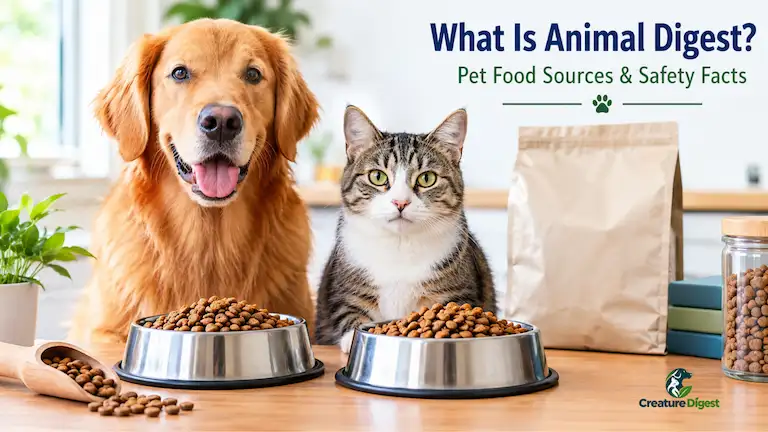
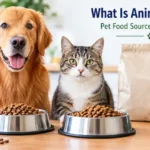
What is animal digest? Animal digest is a liquid broth or dry powder flavor spray coated onto dry dog and cat food to give it a strong meat smell and taste. Under official Association of American Feed Control Officials (AAFCO) Rule 9.68, it’s made by breaking down clean, undecomposed animal tissue with natural enzymes or food-grade acids. This cooking process is called hydrolysis. Under AAFCO 9.68, it can’t contain hair, horns, teeth, hooves, or feathers, while undigested stomach contents and manure are banned under AAFCO 9.3 and state feed adulteration laws.
Open a fresh bag of dry dog or cat food. Before the kibble even hits the bowl, your pet is already running into the kitchen.
Why do pets act like dry kibble is fresh steak?
Raw kibble starts as a wet dough of grains, meat meal, vitamins, and safe root vegetables like potatoes (always double-check before sharing extras, like whether dogs can eat taro). Factory machines push that dough through a hot steam cooker called an extruder. Then it’s baked dry until the moisture drops below 10 percent.
That high heat creates a big problem. It ruins almost all the natural meat smells. Plain baked kibble smells and tastes like dry cardboard. Most cats won’t touch it, and even hungry dogs eat it slowly.
To fix this, pet food makers spray warm kibble with a tasty coating right before bagging it. Flip your pet’s food bag over and check the middle of the ingredient list. Right near the salt and vitamins, you’ll see the name of that secret spray: animal digest.
Those two words scare a lot of pet parents. Online forums claim animal digest is made from roadkill, spoiled store meat, or poop from an animal’s gut. Big pet food brands say the exact opposite, calling it a great protein source.
Neither claim gives you the full picture. Here is how animal digest is really made, what the law allows, and how to know if your pet’s food is safe.
Most people read the words “animal digest” and picture stomach acid, guts, or half-eaten food inside a belly. Animal digest is NOT the contents of an animal’s stomach or intestines. Federal and state feed adulteration laws, AAFCO Rule 9.3 (for meat by-products), and AAFCO Official Feed Terms for animal waste all keep manure, undigested stomach contents, and cow rumen contents out of pet food.
In food science, digest just means how the meat is cooked, not the body part. Think about how your own stomach digests lunch. It uses natural enzymes and weak acids to turn solid food into a liquid soup your body can soak up.
Pet food makers do that same job inside big steel tanks. Enzymes break down the clean animal tissues before the liquid ever touches the kibble, so the finished broth is called an animal digest.
Labs also test the raw meat before cooking to make sure it’s fresh. Using HPLC machines (high-performance liquid chromatography), they check for biogenic amines like histamine, putrescine, and cadaverine, which only jump up when bacteria spoil meat. They also test the fat’s Peroxide Value (PV) and keep it below 5 to 10 mEq/kg so the broth won’t go rancid.
In the pet food business, flavor sprays are called palatants. That just means an ingredient that makes food taste better.
Making animal digest uses a gentle cooking method called enzymatic hydrolysis (hydro means water, and lysis means splitting). Here is how a factory turns raw animal tissues into the savory glaze on your pet’s food.
Workers collect clean, undecomposed animal tissues from meat plants. Depending on the recipe, they gather soft organs like livers, hearts, lungs, spleens, kidneys, muscle trimmings, and clean internal organs (viscera), as well as bony parts like poultry frames, heads, and feet. While soft organs melt completely during cooking, any undigested bone from poultry frames is screened out through fine filters at the end.
Liver is the top choice because dogs and cats love its rich, iron smell. Workers chill or freeze these parts right away so they don’t spoil. At the flavor plant, big grinders turn the frozen tissue into a smooth paste. To stop that thick paste from turning into a stiff gel and clogging factory pipes, workers often mix in 0.5% to 5% food-grade phosphate salts, a method shown in pet food patent WO2011043828A1.
Next, pumps push the meat paste into a warm steel tank mixed with clean water. Workers stir in natural digestive enzymes called proteases, such as papain (from papayas), bromelain (from pineapples), pepsin, or pancreatic and bacterial enzymes.
Technicians adjust the tank’s pH to match the exact enzyme used: an acidic pH 2.0 to 3.5 when using acid-loving pepsin, or a mildly alkaline pH 7.3 to 8.5 (optimally 7.8 to 8.0 using phosphate salts per patent WO2011043828A1) so pancreatic and bacterial proteases can work at peak speed.
The tank heats to 120°F–160°F (50°C–70°C) and stirs for a few hours. Warm enzymes wake up like millions of tiny scissors.
Whole proteins are long chains of hundreds of amino acids. Using water molecules, enzymes cut their peptide bonds into short peptide ribbons and single free amino acids. Soon the thick paste melts into thin liquid broth. Filters catch leftover bone bits.
With the proteins cut to size, workers mix in yeast extract and simple sugars like dextrose or xylose. Heat goes up to 185°F–212°F (85°C–100°C).
High heat stops the enzymes. It also kills bad bacteria like Salmonella, E. coli, and Listeria. Hot amino acids and sugars brown together in the Maillard reaction, making the broth smell like seared steak, roast turkey, or toast.
Finally, workers keep the broth from spoiling. Liquid Animal Digest gets mixed with 75% food-grade phosphoric acid and vitamin E (tocopherol) antioxidants. Dropping the pH to 2.8–3.5 gives it a sour taste pets love and stops bacteria and mold in tanker trucks.
Dried Animal Digest goes one step further. A nozzle sprays the broth as a fine mist into a hot air chamber. Water dries in seconds. Only a brown powder like bouillon soup mix stays behind.
The Association of American Feed Control Officials (AAFCO) sets the U.S. pet food rules states enforce.
All digests follow AAFCO Official Definition 9.68 (Proposed 1978, Adopted 1983, Amended 1990) and AAFCO Official Process Terms. AAFCO’s naming rule says: “If it bears a name descriptive of its kind or flavor(s), it must correspond thereto.” Pet food bags use four names:
| Official AAFCO Name | AAFCO 9.68 Legal Basis | Exact Legal Tissue Allowed | Strictly Prohibited Materials | Transparency Level |
|---|---|---|---|---|
| Animal Digest | Base rule 9.68 (IFN 5-06-935 is Animal Digest Condensed) | Clean, undecomposed mammal or bird tissue broken down by chemical or enzyme hydrolysis | Hair, horns, teeth, hooves, feathers (9.68); manure, stomach contents (state adulteration laws) | Lowest; hides species, which can change every batch |
| Dried Animal Digest | Rule 9.68 + Official Process Term (Dried) | Same hydrolyzed animal tissue with water dried into powder | Hair, horns, teeth, hooves, feathers (9.68); manure, stomach contents (state feed laws) | Lowest, unless an animal is named |
| Digest of Named Species (Chicken Digest, Pork Digest, Digest of Beef) | 9.68 naming rule (“must correspond thereto”) | 100% clean, undecomposed tissue from that one animal (liver, heart, clean viscera, muscle, filtered frames) | Other animal species; hair, horns, teeth, hooves, feathers | Highest; single animal source stops meat swapping |
| Digest of Species By-Products (Digest of Poultry By-Products) | 9.68 naming rule + By-Product definitions | Clean, unrendered internal organs and parts from that named group (livers, hearts, lungs, spleens, kidneys, clean stomachs) | Hair, horns, teeth, hooves, feathers (9.68); poop, undigested stomach contents (AAFCO 9.3) | Moderate to high; names the group and uses rich organs |
Two rules matter most here: “clean and undecomposed animal tissue” and single-species naming.
By law, plants can’t use rotting meat. Under AAFCO 9.68, Chicken Digest or Pork Digest must come 100% from that animal. Plants can use livers or filtered poultry frames instead of steak muscle, never mystery animals.
Holistic vets warn against generic animal digest. USDA-inspected human-grade meat and feed-grade animal tissue are not the same.
Cows, pigs, chickens, and turkeys butchered for grocery stores must pass a USDA inspector. Americans mostly buy pork chops, ground beef, and chicken breasts. Millions of pounds of safe, fresh organs like chicken livers, turkey hearts, and pork spleens go unused.
Good pet food brands buy those clean, USDA-checked organs from human food plants for named flavors like Chicken Liver Digest or Turkey Digest.
Watch out when a bag just lists “Animal Digest” without naming the animal.
The Federal Food, Drug, and Cosmetic Act (FD&C Act) says food from diseased animals or animals dying “otherwise than by slaughter” is impure. Still, for 40 years, FDA Compliance Policy Guides CPG Sec. 675.400, CPG Sec. 690.300, and CPG Sec. 690.500 let plants cook Dead, Dying, Diseased, or Disabled (4-D) animals into pet food if it didn’t make pets sick right away.
Most pet blogs miss what changed on April 30, 2019. In its CVM announcement and final reply to Susan Thixton’s Citizen Petition Docket No. FDA-2016-P-3578, the FDA dropped all three CPG guides. It moved enforcement to the Food Safety Modernization Act, or FSMA Preventive Controls for Animal Food rule under 21 CFR Part 507.
In that April 30, 2019 reply, plus follow-up Citizen Petition FDA-2022-P-1643 and a 2026 Petition for Reconsideration, the FDA refused to make AAFCO limit Animal Digest to slaughtered, USDA-inspected animals. The FDA ruled that if a plant controls germ and chemical hazards under FSMA, using non-slaughtered farm animals won’t automatically trigger an FDA recall.
How this affects your pet:
Pet food has a weird problem: pets and buyers like opposite smells (Samant et al., Foods, 2021).
In nature, dogs and cats love smells from volatile fatty acids, putrescine, cadaverine, hexanal, and 2,4-decadienal. To a pet, that smells like fresh prey. To a human, raw organs smell like rancid grease or a wet barn. If kibble smelled like raw guts, you would stop buying it.
Modern digests solve this in two steps:
Also, a 1% to 2% digest spray covers up the bitter taste of B-vitamins, potassium chloride, minerals, and fish oils.
Pet blogs often say all three are the same. Enzymes cut the protein in each one. Mix them up, though, and an allergic pet can end up at the vet.
Check the Degree of Hydrolysis (DH%) and Dalton (Da) protein size:
| Label Name | Bag Amount | Protein Size (Daltons) & Cut (DH%) | Main Job | Safe for Allergies? |
|---|---|---|---|---|
| Animal Digest | 0.5% to 2.0% (outside spray) | 15,000 to 50,000+ Daltons (10% to 25% DH light cut) | Cheap smell and flavor. | No. Mystery meat and big pieces cause itching. |
| Natural Flavor / Natural Chicken Flavor | 0.5%–2.0% (sprayed or mixed) | 15,000–50,000+ Da (light 10%–25% DH cut) | Nicer name for digest (often with yeast or rosemary). | Only if named (like Natural Salmon Flavor for a dog with a chicken allergy). |
| Hydrolyzed Protein (Vet Diet Grade) | 15% to 30%+ (main protein base) | Under 3,000 to 10,000 Daltons (deep 30% to 50%+ DH cut) | Daily protein for bad allergies or IBD. | Yes. Cut and filtered too small for the immune system to see. |
Dogs allergic to chicken have immune alarm sensors (IgE antibodies on mast cells) that look for whole chicken protein. Pieces over 10,000 to 12,000 Daltons hit two sensors at once. You get itching, hives, or diarrhea.
Vet hydrolyzed protein diets use enzymes to cut 30% to 50%+ of protein bonds. Filters take out pieces over 3,000 to 10,000 Daltons.
Regular animal digest stops at 10% to 25% DH. Cutting smaller tastes bitter (from leucine and phenylalanine amino acids) and costs three times more to filter. Big 15,000 to 50,000 Dalton mystery animal chunks stay in and cause itchy paws and ear infections.
Factories almost never spray pure meat broth by itself. U.S. and European pet food patents show what really goes into kibble flavor coatings, including Mars Inc. (WO2015066009A1 / EP3062626A1), Symrise (US20200154736A1), and AFB International (US20050170067A1). Their recipes mix:
Pet food makers call pyrophosphates “cat crack.” Cats cannot taste sweet sugar. Their taste buds crave amino acids paired with pyrophosphates to make animal digest taste meatier.
Natural phosphorus in chicken or fish muscle digests slowly. But pyrophosphates are soluble inorganic phosphate salts that melt fast in the gut. That spikes blood phosphorus. Vet studies show this strains the kidneys, speeding up Chronic Kidney Disease (CKD), the main killer of senior cats.
For a senior cat or a dog with kidney issues, skip dry kibble with generic digest and pyrophosphates. Feed wet food.
Cheap bags labeled “Beef Flavor Dog Food” often show a steak on the front. Under AAFCO’s 4 naming rules, a bag using animal digest can legally hold 0% real beef.
Some digests are fine. Until 2020, top U.S. vet probiotic Purina Pro Plan Veterinary Supplements FortiFlora listed “Animal Digest” as its first ingredient. Now Purina calls it “Liver Flavor,” made from hydrolyzed pork and poultry liver digest. Live probiotic bacteria are tiny, so this tasty powder fills the packet and helps sick pets eat their medicine.
Healthy pets can safely eat foods that list real meat first and “Chicken Liver Digest,” “Pork Digest,” “Digest of Turkey,” or “Hydrolyzed Salmon” near the bottom. Many Fancy Feast Gourmet Dry recipes do this. Naming the exact animal locks the plant into using clean parts from that single animal.
Skip the food if you see these 3 warning signs:
Do this 3-step store check: